content warning: this piece contains frank discussions about death and dying, surgical procedures and their aftermath, gender dysphoria, and mental illness. read at your own discretion.
I was seven or eight years old the first time I saw a human corpse.
It was at my grandfather’s funeral home, and she was set out on a gurney in the hallway to be taken to be placed in her casket for the viewing. It’s probably a wild thing for anyone to see a dead stranger for the first time, but at that age it definitely made an impression. I was a somewhat anxious child who tried to face their fears as firsthand as possible in order to overcome them, and now I had stared Death in the face, I thought. It helped me process the loss of both my uncle and a close friend and gave me a complex relationship with death and dying at a young age. I wasn’t afraid of being dead, just the dying part, and there wasn’t really anything I could do to face that particular fear. Besides, I would develop plenty of other phobias I would need to punch in the face.
At age 12 I moved across the country from a suburb of Denver, CO, to a suburb of Atlanta, GA, and between the culture shock and the impressive bullying of my fellow 12-year-olds, I developed agoraphobia, which is the crippling fear of leaving your home. My previous social anxieties had compounded significantly in a new place with no friends and peers who made fun of me for everything from the way I spoke to having body odor. (I was pubescent and had never been in Georgia humidity and after one truly horrific comment I started slathering on enough antiperspirant/deodorant and perfume that I probably smelled a whole different kind of awful.) I stopped eating in school first, because I was too nervous to eat. Then I stopped going entirely, and refused to leave the house. I hated the move, I hated my peers, and most of all, I hated my body. The development of breasts and hips and the beginning of my menstrual period felt like a betrayal after over a decade of feeling truly comfortable in my skin. Throughout adolescence I would take out my frustration in a number of (very unhealthy) ways, and I could be a bit reckless, though I tried to embrace the identity of a “tomboy” or what Amy Dunne calls the “cool girl” in Gone Girl (the book/movie). I felt like a boy but couldn’t be a boy, so I would try to be the next best thing. Femininity was a performance and I started to love it — as long as I could stop performing some of the time. I started growing more comfortable in my body and embracing the parts that reminded me of the women in my family who I adored, even if sometimes it still felt annoying and alien.

I overcame my agoraphobia for the most part. I traveled the country on my own and covered entertainment events and interviewed celebrities and did a million things that poor preteen me could have never even imagined. I was still an insecure, traumatized mess (a whole different essay), but I was living. I was living big and I was doing exciting things and I felt resilient. I started seeing my body as a strength, because even though I dealt with some hormonal issues and painful periods, I also could walk the 8 miles in a day I needed to get around Lower Manhattan for Comic Con running on a diet of mixed nuts, soda, and granola bars. I could carry a surprising amount of weight for my size and was durable, and I had a great deal of pride in that. Feeling physically capable helped keep my other fears at bay, including that pesky old one about dying. No matter how my weight fluctuated or how I looked, I felt strong, and that meant a great deal. It had taken me a few decades, but I thought I had a pretty good handle on the whole death and dying thing. (Oh my sweet summer Dani…)
I did an internship in college at CNN Medical, working under Sanjay Gupta. It was absolutely incredible, but it was also the autumn of 2014, and that meant we were covering the Ebola crisis. Part of my job was transcribing raw footage from our team on the ground in Liberia, including footage that was too sensitive to ever make it to television. It was a crash course in tackling my fear of dying even more, and I followed this up with a job as the night reporter for the county newspaper, though I only lasted about five months because the sheer amount of human misery about broke me. There were just too many bodies, and my own was feeling faulty.
It was around this time that my body really started betraying me again. I started getting sicker each month, and for longer stretches of time. I had an exploratory surgery and they found a big ruptured cyst on my ovary and lots of free fluid in my abdomen, causing irritation. The surgery did not go particularly well and recovery was traumatizing, making me start to feel truly at war with my body. Migraines that I had since puberty became more frequent and more painful, and I was desperate for answers. I tried everything from herbal supplements to hormonal treatments to lifestyle changes, and nothing worked. I kept getting sicker. After several years I found a doctor who agreed to remove my uterus and fallopian tubes, but she wouldn’t take my “healthy” ovaries, because they had only been throwing tiny cysts since. The hysterectomy fixed a great deal of my pain because it turns out my fallopian tubes were so full of cysts that they weren’t even really tubes anymore and my uterus was lousy with fibroids, but it didn’t fix any of the hormonal issues, and it didn’t make me feel more comfortable in my body. The motherhood aspects of femininity that I had embraced and longed for were now even more distant, making one of the few things I had found positive in my whole reproductive setup now a profound disappointment. My body was increasingly my enemy.
2020 hit and every effort I hade made to fight my fears was smashed into tiny pieces. The combination of the early days of the COVID pandemic and lockdowns and civil unrest from the George Floyd killing had me convinced the world was ending (again, my sweet summer Dani…) and I didn’t handle it well, to say the least. Even after things started to “get back to normal” for many people, I still felt like I had lived through my own private apocalypse. I started trying to challenge my fears again, making small steps back out into the world. And then I got sicker than I’ve ever been, and hopefully ever will be.
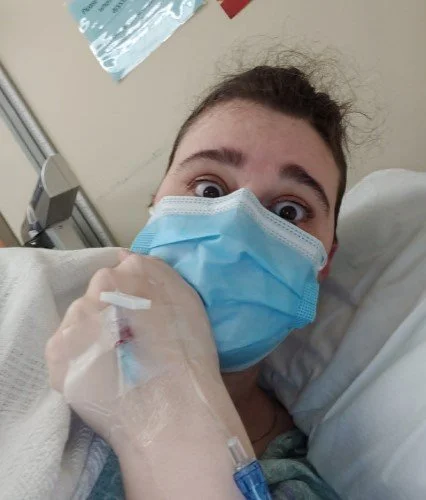
Dani visits the ER
It started when I got my first confirmed case of COVID, having managed to dodge it for years with masking and vaccinations. I was pretty sick but had endured worse flus and such, so I didn’t think too much of it. A few weeks later, I started feeling really weak, and while trying to move boxes in our storage closet my heart felt like it was going to explode. I mentioned something to my husband and we decided to just “keep an eye on it” — maybe I just needed more recovery time from COVID. The problem was that I started getting weaker and weaker. Taking my dog out to use the bathroom became an almost insurmountable task, as my legs felt so heavy trying to go up just a few stairs outside that I was wheezing and clutching my chest. I started having numbness in the left side of my face, the tips of my fingers, and my feet, and my digestive system pretty much stopped working. I lost 30 pounds in about a month, and though I kept checking in with my GP I was given no answers and told it was “probably just Long COVID.” I ended up in urgent care and was told by the not-very-warm doctor there that I “probably had MS.” One rather unpleasant MRI later (the nurse blew my vein and if you’ve ever had the dye blow your vein you know EXACTLY what I’m talking about) and I was cleared of MS, even though I had most of the symptoms and was the right age.
At this point my stomach stopped working entirely and I couldn’t eat anything, so my mom rushed me to the emergency room. I was given fluids, enough ondansetron to fix the morning sickness of a dozen pregnant people, and some follow-up instructions because I had gone into ketosis and they wanted to prevent more of that. (Unintentional keto flu? Not great!) My mom took me back to my parents’ place so she could nurse me 24/7 while my husband worked. We desperately searched for answers and found none. I desperately tried to get in with a neurologist and was given an appointment nearly a year out. Every other doctor we talked to either gave us mostly useless guesses or shut down my attempts to get tested for Guillain-Barre syndrome because it was “so rare” and the tests aren’t exactly fun. (It’s a spinal tap.)
Within a few months of getting sick, I could barely walk, couldn’t lift more than a few pounds, and was sleeping very poorly on account of the numbness and stinging pains in my feet, face, and hands. I didn’t know what the future would look like for me or even what was wrong with me, but I tried to make the best of it. My mom got me a temporary wheelchair from the thrift shop so I could get around, and we started talking about figuring out what kind of wheelchair I would want if this was permanent. I tried to accept a future where I couldn’t rely on my own two feet, and I used a bit of goofy humor to stay hopeful.
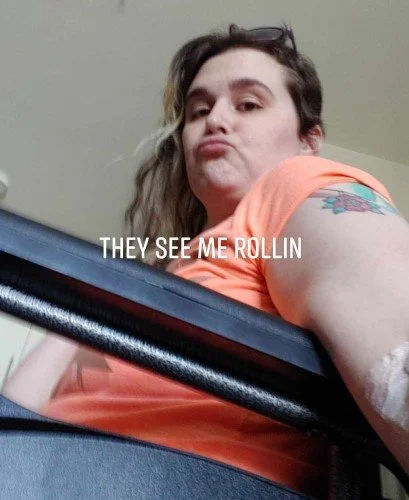
A goofy DM I sent a friend when I first got my temp wheelchair
If I had felt like my body was my enemy before, now it was something else entirely. No part of it was reliable, from my anxious brain to my tingling toes. We didn’t know what was wrong, if it would improve with time or if I would decline even more. I sought joy in the little things and lived day-to-day. After about 4 months, I started seeing improvement. My mom and I would go to the pool and I would walk across it, doing anything to get my strength back. I could walk from my apartment to the front door of the building without falling down. There was hope. I still had all kinds of nerve pain and I was still incredibly weak, but maybe I could have something like my old life again.
Between medical bills and barely being able to work I ended up a special kind of broke, but my parents took us in and everything was more or less fine, even if the additional loss of independence stung like hell. I finally saw that neurologist and he said that I should have been admitted to the hospital by the urgent cares and the emergency room based on my symptoms and that it was almost certainly Guillain-Barre syndrome based on the timeline and presentation. The only problem was that since the syndrome was no longer active, there was no way to fully confirm it. All they could do was test for nerve damage, which concluded that yes, I did have damage to the myelin sheaths on my long nerves, causing tingling, pain, and numbness in my face, feet, and hands. The doctor said that it was as close to confirmation as we would ever get that it was Guillain-Barre, and that now it was just about treating the leftover symptoms, which would probably be with me for life.
These days, as long as I remember to take my nerve meds, the pain and numbness is mostly manageable. My face feels almost normal and my hands only get the tiniest tingles on bad days, though my feet will forever be little torture machines on the end of my body. I will never feel sand between my toes again (trust me, I tried), and that was a bizarre thing to have to mourn. I’ve always been clumsy, but my balance took a serious hit and I am even more of a danger to myself than ever before just from being so accident-prone. My hormone issues didn’t resolve, and I still deal with nausea, intense pain, migraines, and more whenever my estrogen spikes and dips. I’m a sick, broken shell of a person in many ways, and yet I feel surprisingly whole. I’ve faced down the Big One: the idea that I was possibly dying and no one knew why. Not everyone is as lucky as I am. Not everyone survives. Whenever I start feeling bitter about any of it (usually because my feet hurt), I just remember that the neurologist told me that I could have died. That I was here, and that’s what really mattered.
I spent a lot of time thinking about bodies while I was stuck in bed and contemplating my own potentially imminent mortality. I thought about loved ones who had died young, some whose bodies betrayed them with upsetting finality. I thought about my friend who died at 14 from an oversized heart and my uncle who succumbed to cancer in his early 30s, about the sheer chaos of it all. Even if you somehow manage to live a life where you avoid accidents and disasters, your own body could just be waiting to unleash its own hell. Disease and degeneration come for us all, no matter how hard some might try to avoid it. So instead of viewing my body as my enemy, I’ve started to see it as a frustrating friend who needs a little more patience sometimes. (I will never be able to fully consolidate the idea of my self and body being one and the same, I am way too transhumanist for that, and in a dream world I would love to upload into the cloud or have a fully-functional android body, thank you very much.)
I thought about the old lady on the stretcher, the young woman whose body I saw carried away from behind an auto mechanic’s dumpster when I was a reporter, the piles of bodies in Liberia from Ebola, the freezers full of COVID victims in the earliest days of the pandemic. Fear and sadness became pity for stories cut short, and it made me more resolute in living as big and boldly as I can, while I can. Some of that means knowing when to walk away from a toxic situation, even if it’s scary and it hurts. Some of that means telling my anxiety and depression to kick rocks so I can enjoy being in the moment. But most of all? It means loving myself for who I am, taking better care of myself, and truly befriending my body even if it’s a real jerk sometimes.
I guess all of this is a very long-winded, slightly solipsistic way of saying that life is too short to be unhappy. Chase your dreams, set healthy boundaries, and live.
Frank gets it.
